

Electronic Signature and Digital Signing Solutions
Whether you're signing contracts, onboarding customers and employees, or sealing official documents, Entrust offers a flexible, high-assurance solution you can trust. Our digital signature solution drives efficiency and optimization for workflows across industries, including healthcare, government, and finance. Its streamlined features are designed to ensure a frictionless user experience rooted in trust and compliance.

Prevent document fraud
All e-signatures backed by document sealing and timestamping to help ensure authenticity, integrity and non-repudiation
Ease the user experience and reduce friction in customer journeys
Anywhere access via web portal, mobile device, or REST API integration
Speed up confirmation and approval processes
Fast, compliant ID verification with passport, eID, and eIDAS support
Address regulatory compliance
Meets UETA, eIDAS, GDPR, and ISO 27001 with certificate and timestamping tools
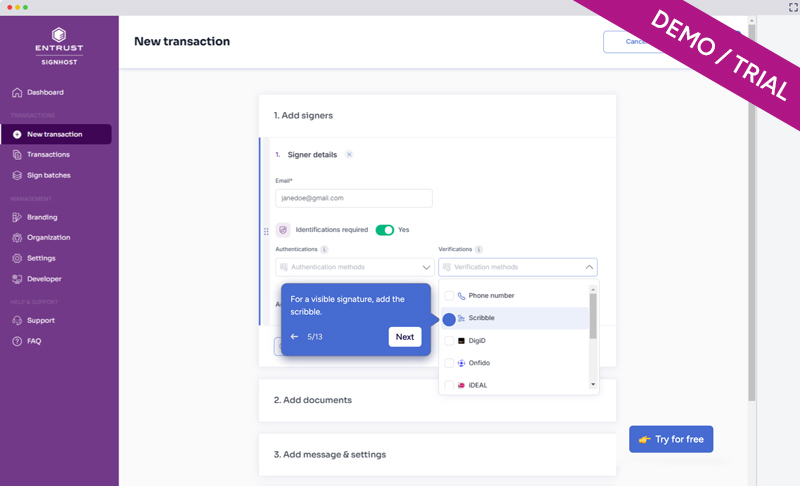

A complete platform for digital signing and identity-based trust
Manage all your e-signature and document sealing workflows with Entrust Signhost. Our cloud service is available via our web portal, mobile app, or by integrating our REST API into your environment.
Your digital signature solution for all eIDAS levels

Simple Electronic Signature (SES)
Email-based signatory identification with scribble to capture the intent to sign evidence:
- Scribble
- SMS One-Time Password
- Qualified timestamping (LTV-enabled)


Advanced Electronic Signature (AES)
Electronic signature solutions with enhanced signatory identification methods:
- Scribble
- ID or passport verification
- Government or Bank eIDs (available in some countries)
- Biometric verification
- Digital sealing and timestamping (LTV-enabled)

Qualified Electronic Signature (QES)
Electronic signature solutions with a regulated identity verification and qualified certificate:
- Scribble
- eIDAS-compliant identity verification
- Digital signature using qualified certificate
- Qualified timestamping (LTV-enabled)
Antel partnered with Entrust to deploy TuID, a nationwide remote digital signing platform that enables over one million users to securely and legally sign documents electronically across devices while achieving accreditation as Uruguay’s official Trust Service Provider with centralized cryptographic key custody.
Other Entrust products compatible with Signhost to enhance your e-Sign solutions
Signing with International Remote IDV
Best-in-class AI-driven ID verification service for e-sign solutions with remote identity verification across more than 195 countries.
Signing with Qualified Electronic Signature (QES) for Contract Signing
Accelerate high-value agreements with confidence. Learn how organizations can verify identities, apply qualified electronic signatures, and maintain compliance-ready records while improving efficiency and customer experiences.
Signing with Federated Identities
Comprehensive IAM service that can provide Single Sign-On (SSO) capabilities for:
- Employees logging in to Signhost
- Signatories to sign using their federated identity
Use cases for digital signature solutions
Digital Onboarding
Accelerate new hire paperwork with secure, compliant, and mobile-ready digital signing. Get employees started faster, wherever they are.
Enterprise Workflows
Digitize approvals across departments with seamless, secure and auditable signatures that integrate into existing document systems and reduce bottlenecks.
Government & Public Sector
Secure digital signatures help agencies issue permits, process benefits, and authorize contracts while meeting compliance requirements like eIDAS.
UAB-Online Enables Fully Digital, eIDAS-Compliant Workflows
Learn how UAB-Online improved efficiency and safety with fully digital, eIDAS-compliant maritime workflows through Entrust eSignature solutions.
Help ensure authenticity and integrity of digital documents
Entrust Signhost is a digital signature solution that can generate digital seals, which carry the identity of a legal organization instead of an individual. Much like a digital signature, a digital seal uses digital certificate technology to prevent document tampering. When combined with timestamping, it can help to guarantee the existence of a document and/or a signature from a specific date and time.
Advanced Electronic Seals
Signhost can generate advanced electronic seals, in multiple scenarios:
- For each electronic signature on a document
- For any PDF document, unrelated to any signing request, just to benefit from the integrity, authenticity and non-repudiation features of a digital seal – this process can be manual using our web portal, or automated using our REST API
eIDAS Qualified Electronic Seals
Signhost can also generate eIDAS qualified electronic seals, which are a regulated version of the advanced seals and provide the highest level of recognition in the EU.
They can be used in the same scenarios as for advanced electronic seals.
Related Resources
Advanced Electronic Signatures with Remote Identity Verification
Build and integrate e-signature workflows that include a remote identity verification of your signatories and meet the eIDAS advanced level.
Transforming Digital Customer Onboarding for European Financial Institutions
European banks simplify onboarding with secure, compliant digital workflows.
Electronic Signatures With Remote ID Verification
Build and integrate e-signature workflows that include a remote identity verification of your signatories.
Digital Sealing for PDF Documents
Help ensure the integrity, authenticity, and non-repudiation of your digital documents with sealing technology from Entrust Signhost.
Looking for secure, compliant e-signatures that scale with your business? Our digital signing experts are here to help. We’ll walk you through how we can tailor our suite of digital signature solutions to match your workflow perfectly. Start the conversation today and see how digital signing can move your organization forward.
FAQs
What are electronic and digital signatures, and how do they work?
Electronic and digital signatures are ways to sign documents electronically. Electronic signatures capture intent, like clicking “I agree” to a site’s terms and conditions, while digital signatures use cryptographic technology to verify the identity of the signer and protect the document from tampering.
What are the differences between electronic and digital signatures?
An electronic signature is a broad term that includes any electronic process indicating agreement. A digital signature is a specific type that uses certificates and encryption to authenticate identity and ensure document integrity.
Are electronic and digital signatures legally binding?
Yes, both are legally binding in many countries when they meet requirements like signer intent, consent, and record integrity. Digital signatures often provide a higher level of assurance and are typically required for regulated industries or transactions that cross borders.