

On-Demand Demos and Free Trials
Deliver the protection your users deserve. Discover Entrust's unmatched security solutions in the demos and trials below.
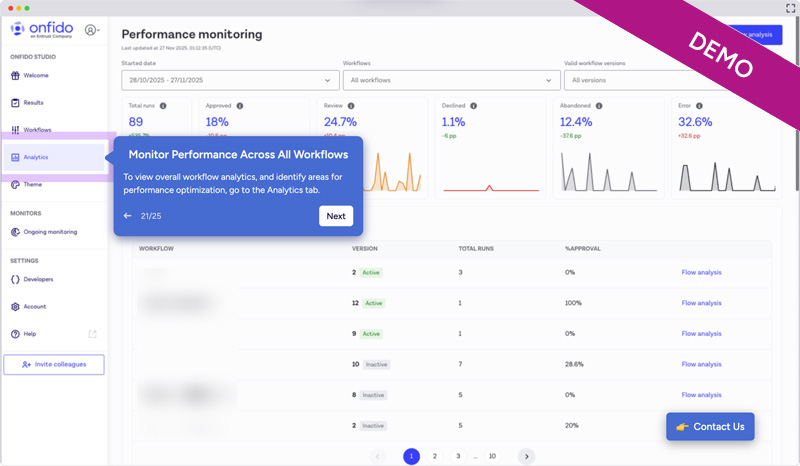
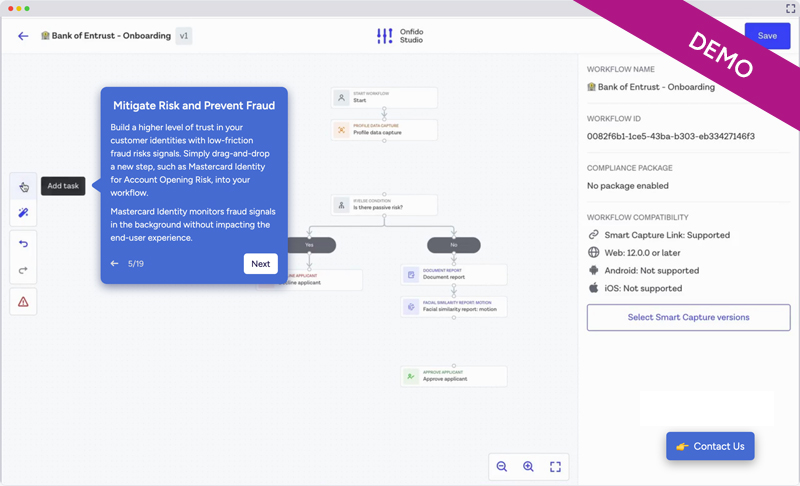
Drive customer acquisition, prevent fraud, and meet compliance requirements.
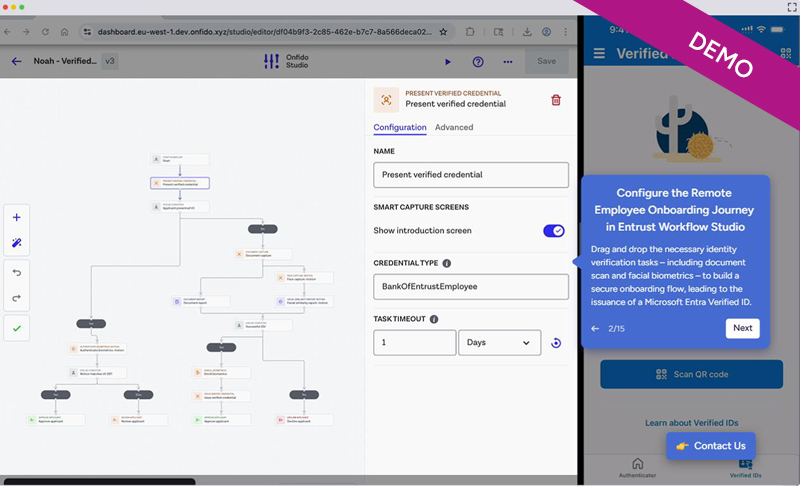
Secure the remote employee onboarding experience and ensure your workforce remains protected against sophisticated AI-driven threats during high-risk moments.
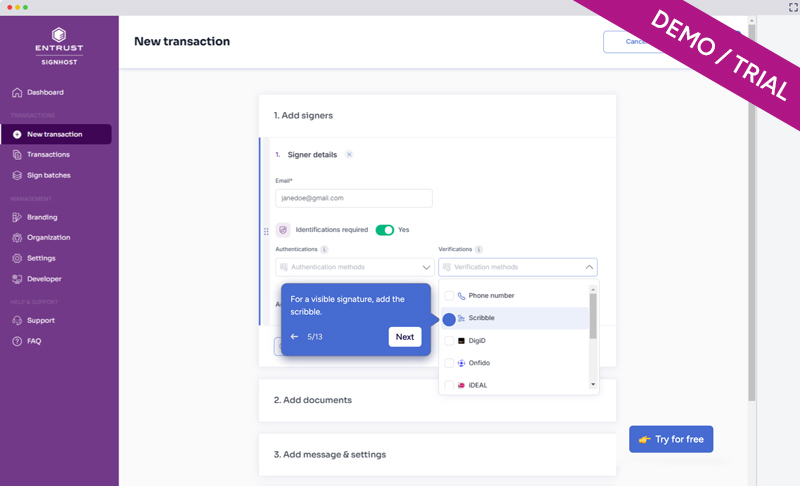
Sign your documents from anywhere with one compliant e-signature platform.
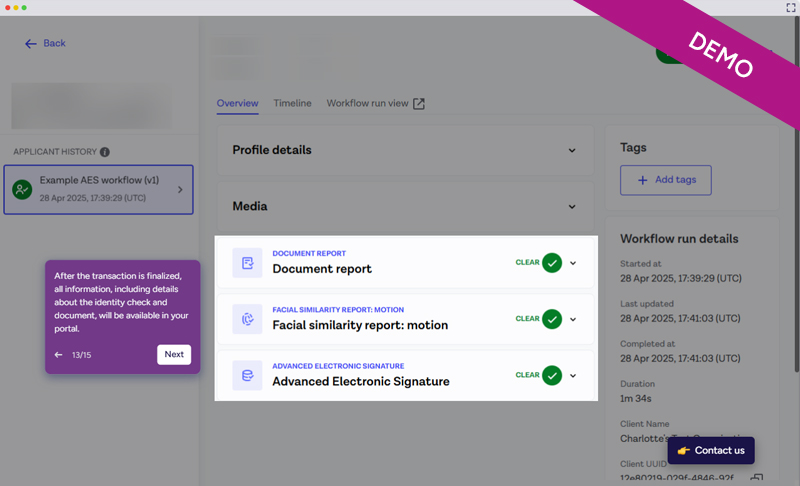
Onboard customers faster by combining identity verification and e-signatures in one platform.
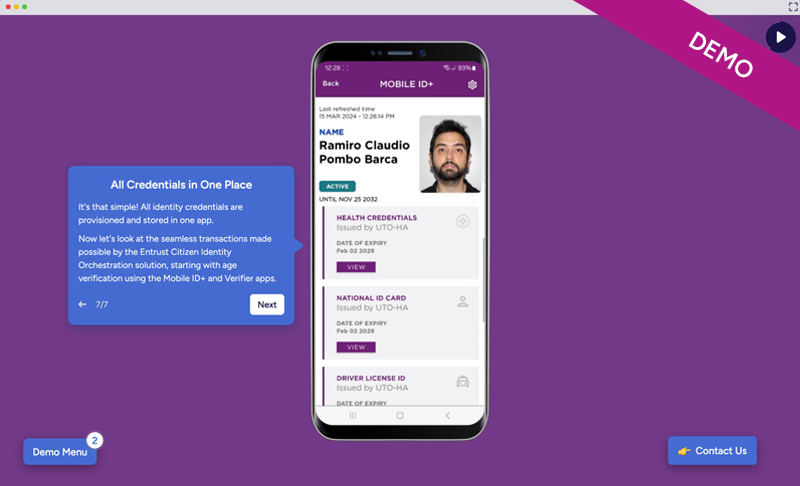
Onboard, issue verifiable credentials, and orchestrate a seamless experience for citizens accessing digital government services.
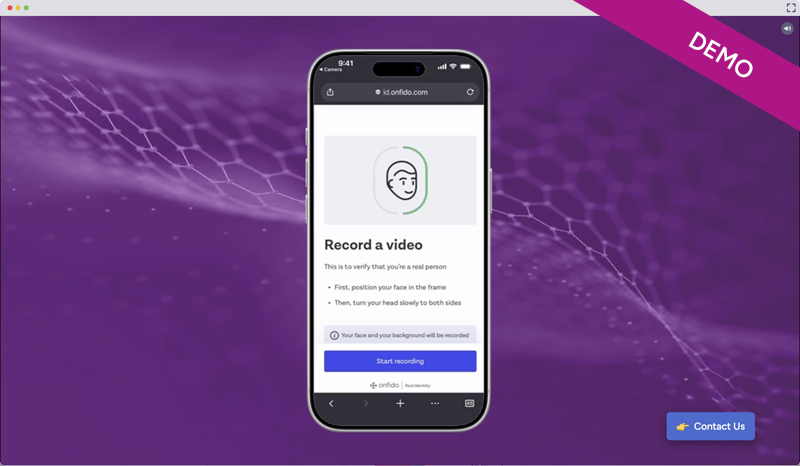
Secure Microsoft Entra ID password resets for employees with Entrust Identity Verification.
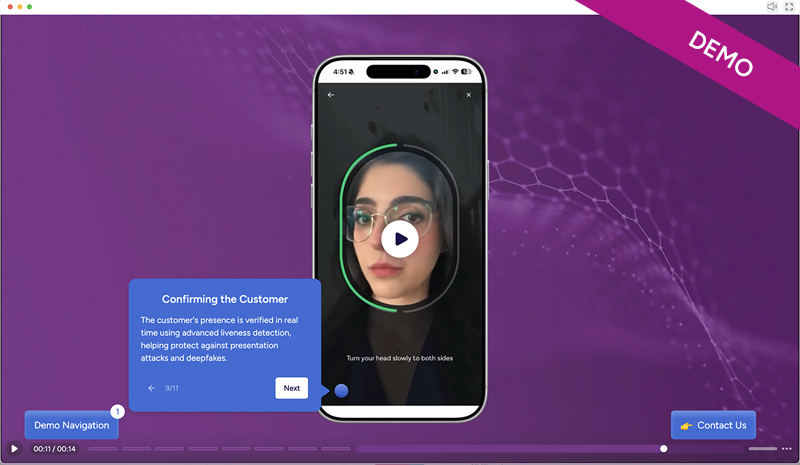
Secure the customer identity lifecycle and prevent account takeovers with phishing-resistant passkeys.
Entrust Biometric Passkey combines phishing-resistant passkeys with verified identity to protect against account takeover attacks across enrollment, authentication, and account recovery journeys.
Enrollment begins with a standard username and password sign-in. The customer is then prompted to enroll a phishing-resistant passkey for future passwordless authentication. Before the passkey is created, identity verification is performed by scanning a government-issued ID document. A biometric check using liveness detection confirms the customer is a real person and guards against presentation attacks and deepfakes. The passkey is then bound to the verified identity and stored on the customer's device. The binding links the passkey to a verified individual rather than just the device.
For everyday authentication, returning customers tap to initiate sign-in using the stored passkey. Face ID or device biometrics authenticate the customer, with no password, SMS code, or OTP required. The process completes in seconds.
When a transaction exceeds a defined risk threshold, a step-up authentication request is triggered. The customer completes a biometric verification, and a live biometric is compared in real time against the identity enrolled at registration. If the match is confirmed, the transaction is authorized. This step-up flow reuses the trusted identity from enrollment without requiring passwords, one-time codes, or knowledge-based questions.
For account recovery on a new or replacement device, the original device-bound passkey is no longer available. The customer identifies their account and completes a biometric verification to confirm they are the same individual who originally enrolled. Once identity is confirmed, a new passkey is created and bound to the account, restoring passwordless access without help desk intervention or password resets.
The identity established at enrollment is reused across everyday login, high-risk transaction approval, and account recovery.
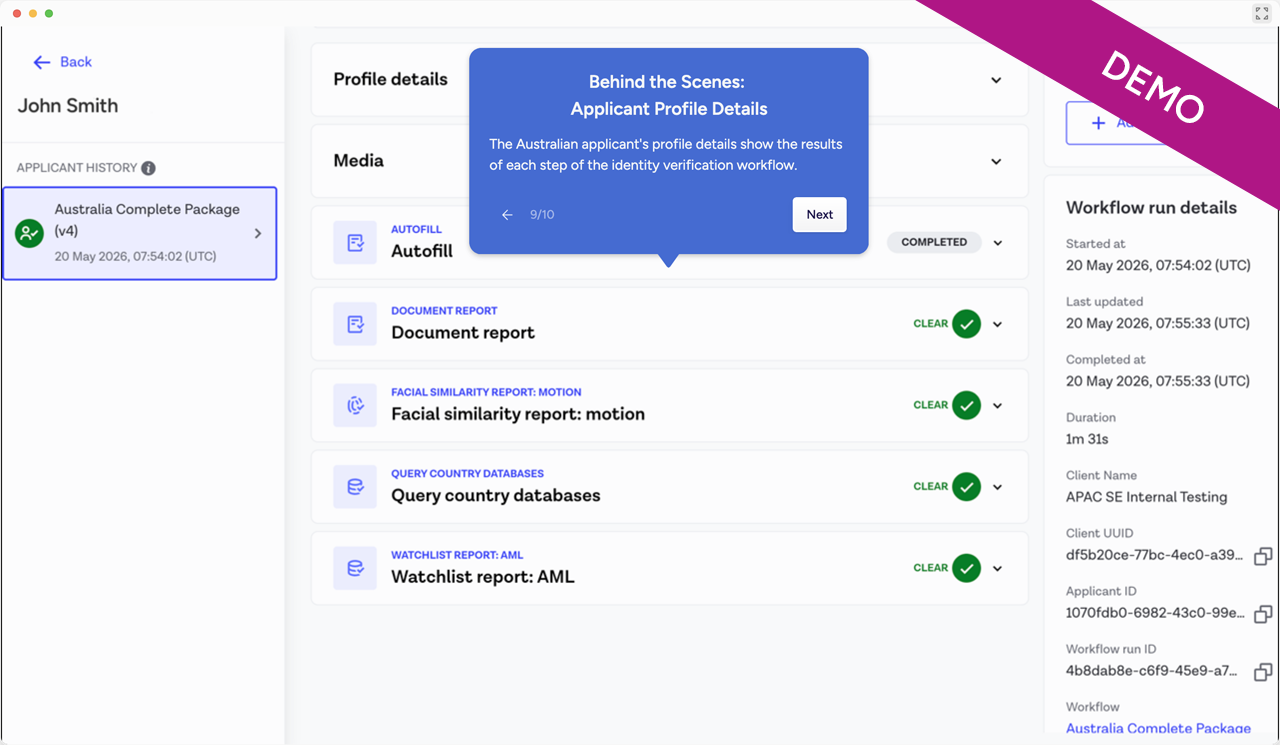
Navigate Australia’s new KYC/AML regulations, prevent fraud, and onboard customers quickly and securely.
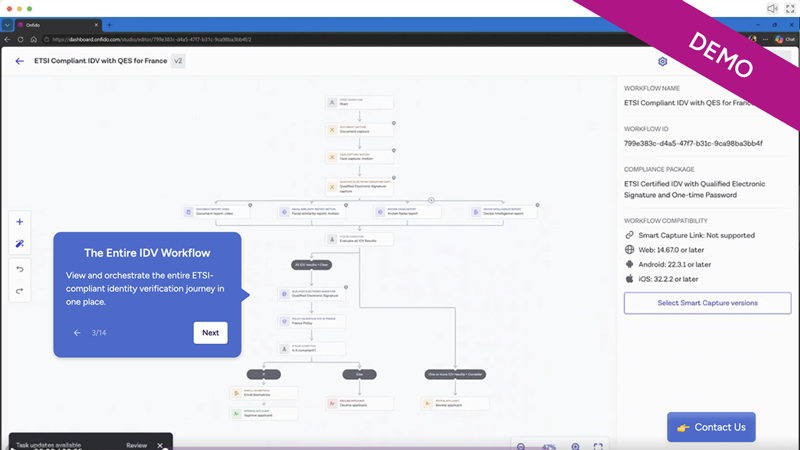
Deploy identity verification with qualified electronic signatures in France with a single workflow
Entrust Workflow Studio supports orchestration of identity verification, fraud checks, and qualified electronic signatures in a single workflow. The platform offers no-code, drag-and-drop editing and built-in workflow templates, including compliance packages.
The ETSI Compliant IDV with QES for France workflow is a pre-built template compliant with Article R561-5-2 of the French Code monétaire et financier and ETSI 119 461. The workflow is viewable and configurable in a single interface.
Workflows contain three task types: Capture Tasks define what end users see and what actions they must take, such as capturing ID documents, faces, or biometric motions; Processing tasks run automated checks in the background; Decision Logic determines how the workflow proceeds based on results.
Certain tasks are locked and cannot be deleted, ensuring mandatory compliance steps remain in place. Customer-facing capture steps include identity document capture, face capture, and document signature.
In the qualified electronic signature capture step, the user reviews and signs a document, establishing a trusted link between the verified identity and the electronic signature. The document signed is typically a standard document such as terms and conditions.
Automated processing reports include a Document Report that analyzes the captured identity document video to detect fraud, prevent injection attacks, and verify document authenticity. A Face and Liveness Validation report detects deepfakes, injection attacks, and spoofing attempts. An optional Known Faces Report flags repeat face usage across onboarding attempts. A Device Intelligence Report checks that the same device was used to capture both the document and the face, to prevent injection attacks.
Automated decisioning routes compliant applicants to QES and directs exceptions for manual review.
QES provides the highest level of signature assurance under eIDAS, combining document authentication and identity verification. Document authentication creates legal evidence and reduces signing risk. Identity verification supports AML and KYC requirements for digital onboarding.
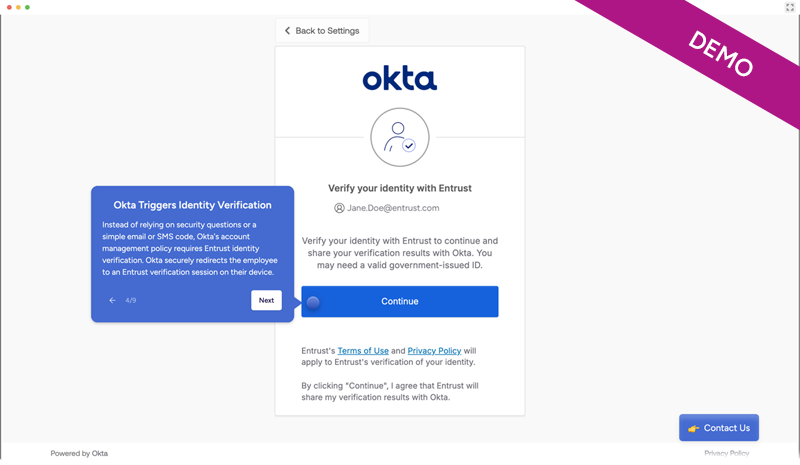
Secure the password recovery process in Okta Workforce Identity with Entrust Identity Verification.
Entrust Identity Verification integrated with Okta Workforce Identity adds biometric identity verification to the self-service password reset process. Instead of relying on security questions, email codes, or SMS codes, the system requires a live biometric check to complete account recovery, preventing account takeovers even when a password, inbox, or device is compromised.
Setup is a one-time admin configuration in Okta. In the Okta Account Management Policy screen, the admin adds a rule requiring Entrust Identity Verification for password recovery and points the password authenticator's self-service reset to that policy. No custom code is required. The rule-based configuration means verification is triggered only at defined high-risk moments, such as account recovery.
When an employee initiates a forgotten password reset by selecting "Forgot password?" on the Okta sign-in page and entering their corporate username, Okta evaluates the account management policy to determine recovery requirements. Rather than proceeding with a standard verification method, Okta securely redirects the employee to an Entrust verification session on their device.
The employee completes a liveness check using facial biometrics. The biometric technology is iBeta PAD Level 1 and Level 2 conformant, designed to detect presentation attacks and AI-generated threats such as deepfakes.
If verification succeeds, Entrust returns a confirmed result to Okta, which authorizes the account recovery and allows the employee to set a new password. If verification fails due to a detected deepfake, presentation attack, or biometric mismatch, Entrust returns a failed result, Okta denies the recovery action, and the password is not reset.
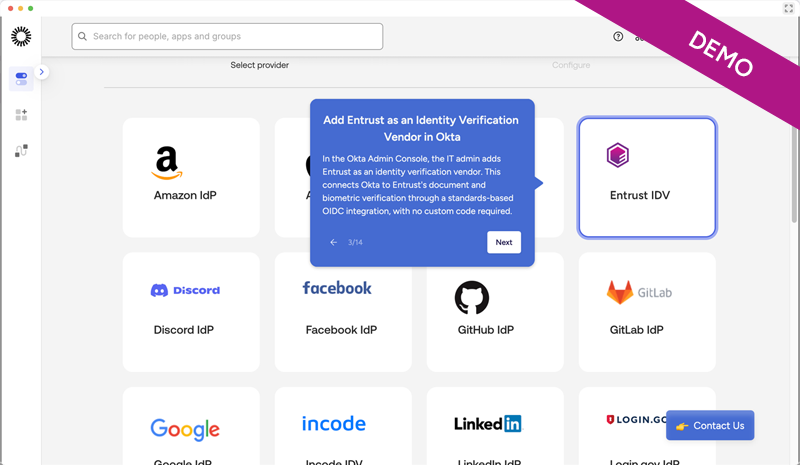
Secure employee onboarding in Okta Workforce Identity with Entrust Identity Verification.
Okta Workforce Identity integrated with Entrust Identity Verification to add identity assurance during employee onboarding. The integration uses a standards-based OIDC connection with no custom code required. It is designed to counter deepfakes, synthetic identities, AI-driven social engineering, and account takeovers by verifying the real person behind credentials, not just the credentials themselves.
In the Okta Admin Console, an IT admin adds Entrust as an identity verification vendor, connecting Okta to Entrust's document and biometric verification services. The admin then configures an authentication policy rule that requires identity verification at onboarding, allowing verification to be triggered at specific high-risk moments rather than universally. A drag-and-drop Workflow Studio is used to build the onboarding flow by adding tasks including document scan and facial biometrics.
From the employee side, a new hire receives an activation email and is prompted to verify their identity with Entrust before completing account setup. The employee selects the issuing country and type of government-issued ID (such as a passport or driver's license), then captures photos of the front and back of the document. The system automatically checks document authenticity and data consistency. The employee then completes a selfie with a liveness check. Entrust's iBeta PAD Level 1 and Level 2 conformant biometrics match the selfie to the ID photo and protect against presentation attacks and deepfakes.
After Entrust validates both the document and biometric results, the outcome is returned to Okta. Once identity is confirmed, the employee continues account setup. The verified result is tied to the employee's Okta identity for future high-assurance actions such as account recovery. Upon completion, the employee accesses their Okta dashboard with verified identity established from the first login.
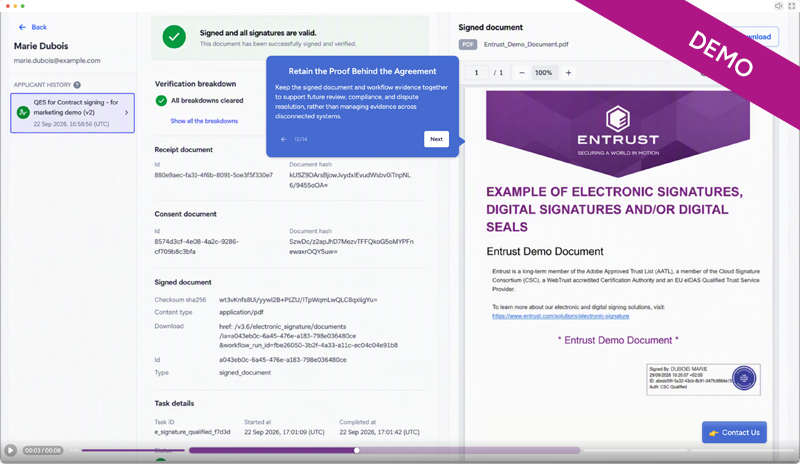
Verify the identity of the person signing, apply a qualified electronic signature, and retain evidence for future review.
Entrust QES for Contract Signing demonstrates how identity verification, qualified electronic signing, policy checks, decisioning, and audit evidence are combined into a single configurable workflow built in Entrust Studio.
The workflow is configured in Studio, where identity verification, document review, signing, and completion steps are assembled and can be previewed before publishing. Studio evaluates identity and signing results against configured conditions and routes the transaction to approval or review, applying a consistent process without manual handling of each agreement.
The signer journey begins with identity verification. The signer uses a phone camera to capture their passport and complete a motion-based facial biometric step. Document capture establishes who is signing, and face capture connects the person completing the journey to the identity document presented.
Once document and face captures are submitted, the workflow moves the signer to contract review. Multiple documents can be supported within a single transaction. The signer reviews the agreement, approves certificate issuance, and applies the qualified electronic signature, directly linking verified identity to the signing event.
After signing, the workflow produces an approved result confirming that identity verification, qualified signature, and policy checks completed successfully. The signed document and all workflow evidence are retained together in an evidence view, covering identity, signature, policy, and workflow outputs. This supports future review, compliance, and dispute resolution without managing evidence across separate systems.
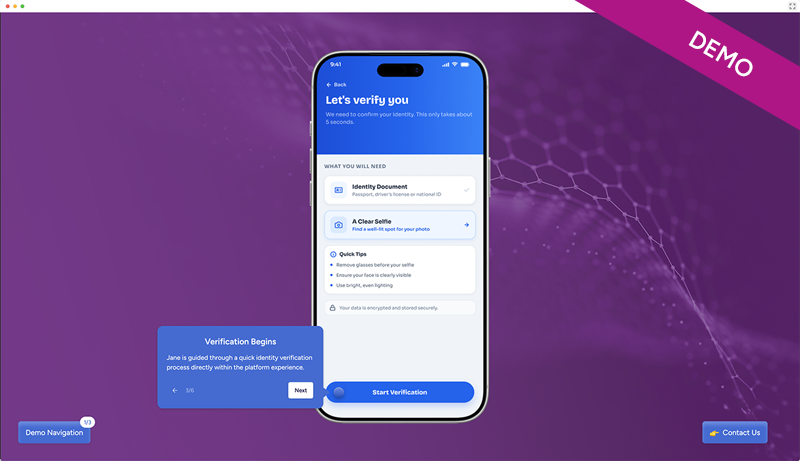
Establish a verified identity at onboarding and confirm it's the same person at key moments.
Entrust helps gig and marketplace platforms establish a verified identity at onboarding and maintain trust throughout the account lifecycle. Different verification methods can be applied at different moments based on the level of risk and assurance required.
During onboarding, a new driver verifies their identity by capturing their driver's license and a selfie directly within the platform experience. Entrust Instant Document Verification automatically verifies the identity in seconds, establishing a trusted identity that can be reused for future authentication and verification moments throughout the account lifecycle.
At shift start, before the worker goes online, the platform runs a biometric check against the identity established at onboarding. This is a periodic check-in rather than a full re-verification. The user's live face is matched to the onboarding biometric without passwords, document rescanning, or support interaction. This check can be triggered at shift start or other routine account access moments. It addresses the gap where account sharing and account rental occur after onboarding is complete.
At high-risk moments such as payout requests or account changes, the platform's risk logic triggers a step-up verification automatically based on the action and surrounding signals. This uses Motion Authentication to provide stronger identity assurance when the level of risk increases, helping confirm a live person is present before a transaction proceeds.
Entrust supports fully automated decisions at sign-up, routine biometric check-ins, step-up verification at payouts and account changes, and is applicable to platforms built around couriers, sellers, hosts, renters, or freelancers.

Streamline enterprise-wide cryptographic management with one unified security platform.

Manage encryption keys across hybrid environments—secure, automated, and compliant.
Secure your cloud infrastructure—centralized access, compliance, and visibility in one solution.
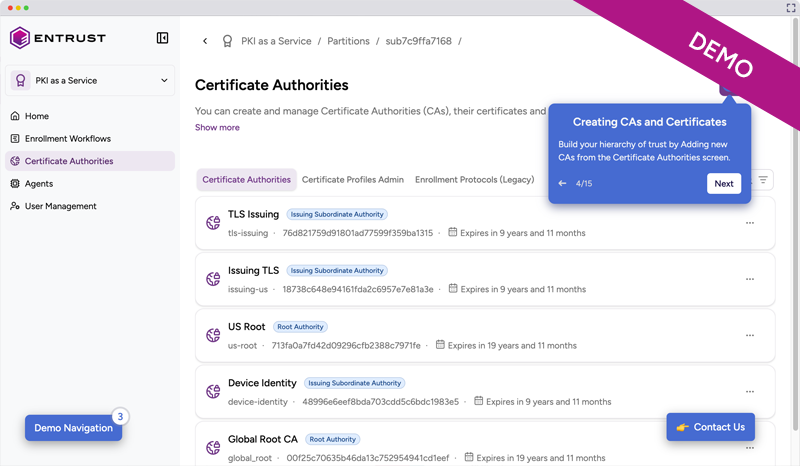
Deploy secure, scalable PKI built for modern enterprise needs in minutes.
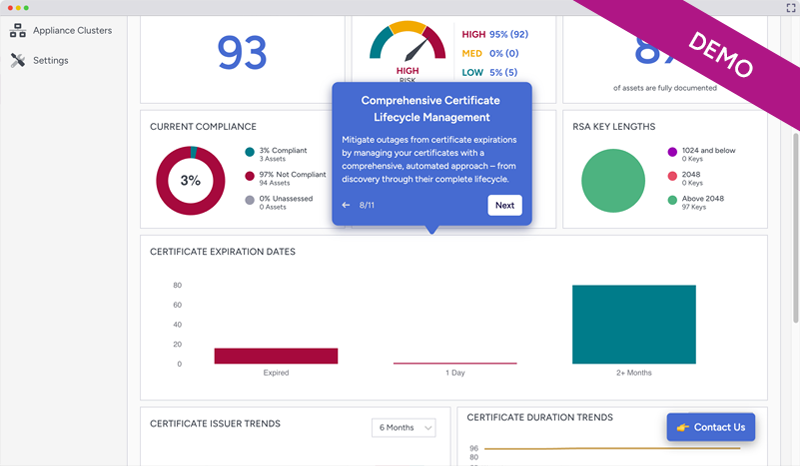
Manage your PKI and all your cryptographic assets with one unified security platform.

Issue secure, spend-ready digital cards instantly from your banking app.
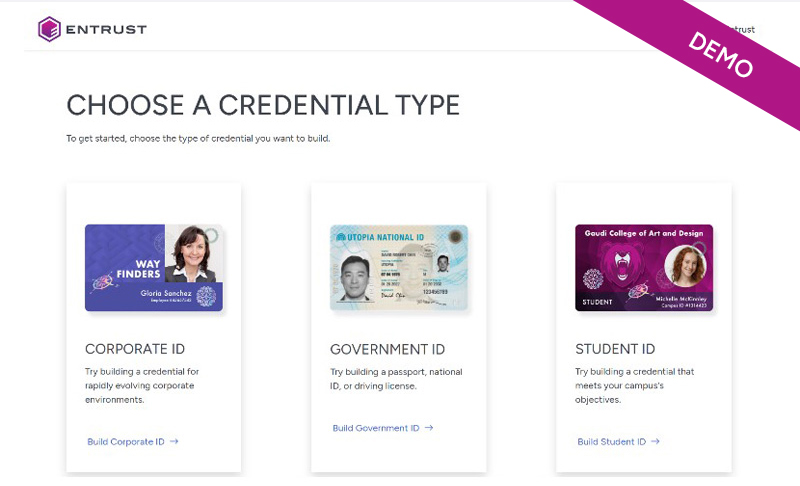
Explore secure credential issuance for corporate, government, or student IDs.
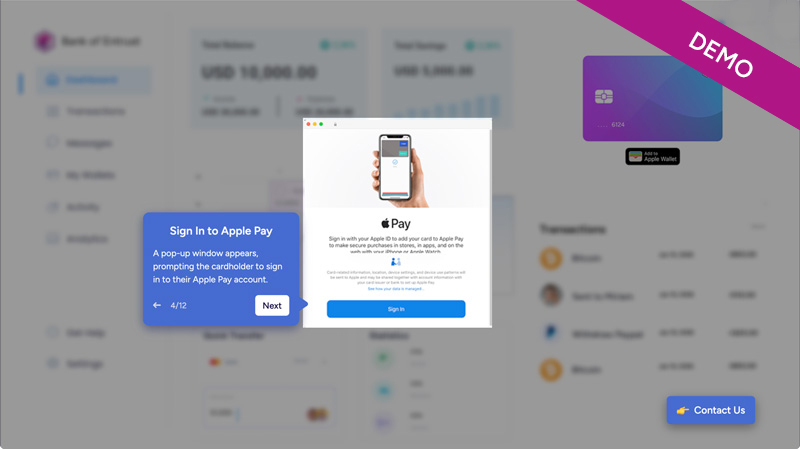
Enable cardholders to add cards to their digital wallets from any web browser.
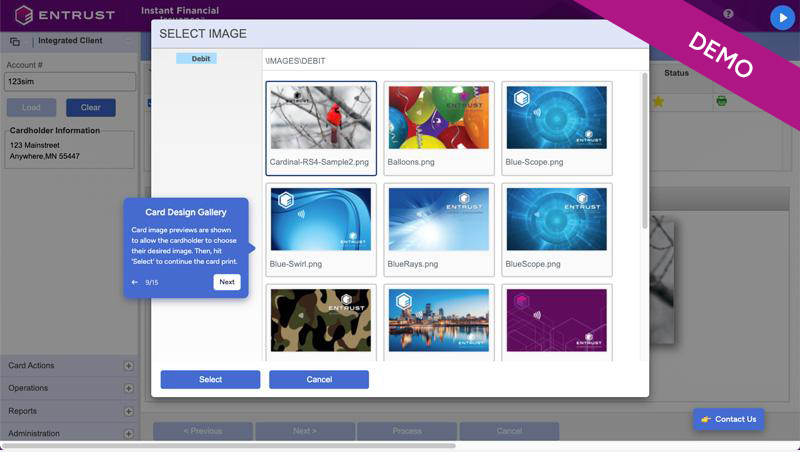
Instantly issue ready-to-use credit and debit cards to your customers.
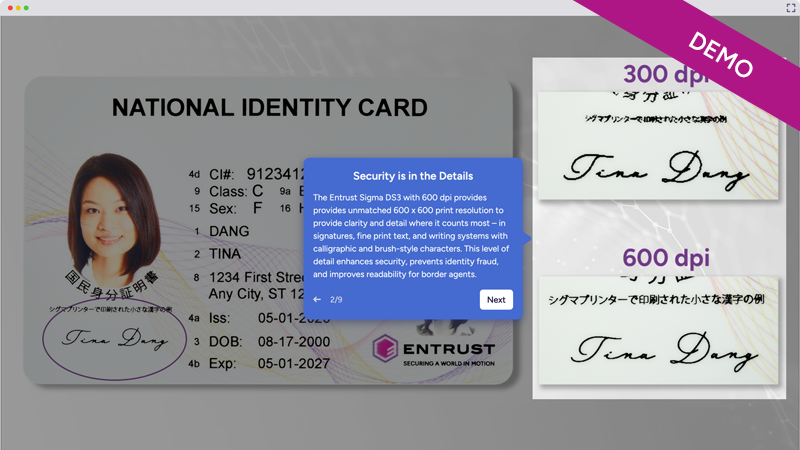
See the benefits of 600 dpi printing for ID cards and employee badges.
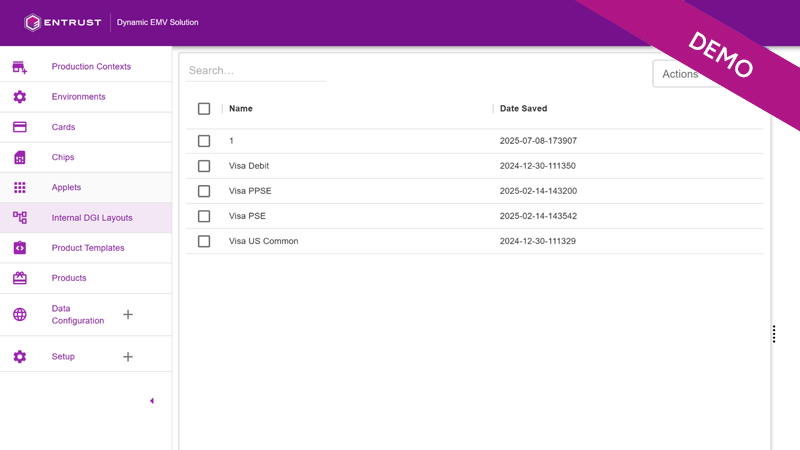
Explore our EMV data preparation and personalization platform for central card issuance.

Issue secure IDs instantly from the cloud with one secure platform.
Ready to get started?
At Entrust, we're laying the secure foundation that protects identities, payments, and data and advances your organization in an ever-changing world.