

Biometric Authentication Solutions Help Prevent Account Takeover (ATO)
During high-risk moments, such as password resets and high-value transfers, fraudsters take advantage of the same access points that your customers rely on. Traditional defenses aim to distinguish between a fraudster and a legitimate user, but often fail.
Entrust biometric authentication solutions help verify the real account holder with the right level of assurance at every step, while deterring the fraudsters – meaning your customer’s experience is fast, secure, and seamless.

Secure every high-risk moment, not just the login
Verify the real identity behind risky transactions
of fraud-driven revenue loss is tied to ATO
Source: TransUnion, Top Fraud Trends Report
of security leaders say insider risk is a significant concern for their organization
believe selfie authentication is better than their current method
Source: Entrust Biometrics Survey

Traditional Authentication Must Evolve Faster Than ATO
Organizations need authentication that verifies the person, not just the password, device, or access code. Legacy multi-factor authentication (MFA), one-time-passwords (OTPs), and other traditional methods struggle to keep up with AI-assisted attacks. Some common challenges are:
- Basic liveness checks don’t match today's deepfakes and injection attack threats
- Customers feel friction (OTP loops, account lockouts) during high-value transactions and sensitive changes
- Separate point solutions don’t communicate past their immediate function, such as IDV at onboarding and OTP at login
- Assurance levels are pre-set and applied to every moment, whether the risk is perceived as low or high
During account takeover, fraudsters mimic legitimate users and navigate trusted flows undetected. That’s why verifying the person behind the identity is key.
Biometric Authentication Solutions That Scale With Risk
Entrust biometric authentication connects the same verified identity across every high-risk moment, from everyday login to account recovery to sensitive account changes. The person who enrolled is the person who authenticates, every time. Attackers can't fake that. Your real customers barely notice it.
Motion Authentication
During moments of high risk, when you cannot afford to be wrong, motion authentication delivers. Active liveness detection, independently certified to ISO/IEC 30107-3 PAD Level 2, confirms a real, verified human is present, not a deepfake, synthetic identity, or injection attack. Built for your high-stake moments.
Face Authentication
When risk is elevated but frequent, face authentication confirms that the real account holder is present without adding steps to their experience. Passive liveness detection matches against the verified identity established at enrollment, stopping spoofing attempts while keeping the flow invisible to legitimate users.
Biometric Passkey
For everyday access, biometric passkey feels exactly like unlocking your phone, a glance or a fingerprint, nothing more. When risk is elevated, it goes further. The same passkey triggers a real-time biometric match against the verified identity established at enrollment, confirming it's really them, not just their device. One credential, from routine login to risky moments.
Discover the right authentication that secures your business across every scenario.
A Practical Guide to Account Takeover Prevention
Account Takeover fraud attempts are rising. Traditional authentication measures have left identity gaps in the past. See how biometric identity authentication can help you protect your business and its reputation now and in the future.

Over two-thirds (68%) of consumers would choose biometrics when they believe those steps improve protection.
Secure Every Moment With Confidence
One Platform, Full Coverage
Most vendors solve one piece: onboarding, or login, or recovery. Entrust connects authentication across every high-risk moment, so the verified identity created at onboarding becomes the anchor for every decision that follows.

Risk-Adaptive, By Design
The right authentication method triggers at the right moment, driven by your team's risk signals. Face authentication for elevated risk, and motion authentication when the stakes are highest. In all cases, our solutions fit within your existing IAM, without the need to rip and replace.
Cryptographic Trust, Not Just Detection
Device-bound keys stored in hardware-backed secure storage mean credentials can't be phished, cloned, or synced to an attacker-controlled device. Trust that goes deeper than liveness detection alone.
Create The Right Assurance at Every Step
We connect the verified identity established at onboarding to every high-risk moment that follows.
Identity verified at onboarding
Document and biometric verification establish an initial trusted identity. That biometric template becomes the reference for future authentication flows.
Everyday access that stays frictionless
Biometric passkey keeps the experience fast and native, a face turn or a fingerprint, backed by a device-bound, phishing-resistant credential
Risk signals that trigger the right step-up
When your risk engine flags elevated activity or request, Entrust biometric authentication solutions step in. The customer completes a biometric check; the attacker can't.
Recovery doesn't become the back door
Account recovery is one of the most-exploited moments in ATO. Entrust helps prevent account takeover with biometric authentication tied to the original verified identity.

Integrates with existing IAM environments, including Microsoft Entra ID.
Resources
A Practical Guide to Account Takeover Prevention
Account Takeover fraud attempts are rising. Traditional authentication measures have left identity gaps in the past. See how biometric identity authentication can help you protect your business and its reputation now and in the future.
Account Takeover Fraud – The Threats, Consequences, and Protection
Explore how account takeover fraud doesn’t follow a script to build a defense that doesn’t rely on static rules.
Principal Financial Group Addresses Online Fraud with Biometric Authentication and IDV
Discover how Principal Financial Group teamed up with Entrust to reduce account takeovers with biometric authentication.
Build Digital Trust With Biometric Authentication
Learn how consumers view biometric authentication today and discover how trust, fraud, and evolving expectations are shaping the future of IDV.
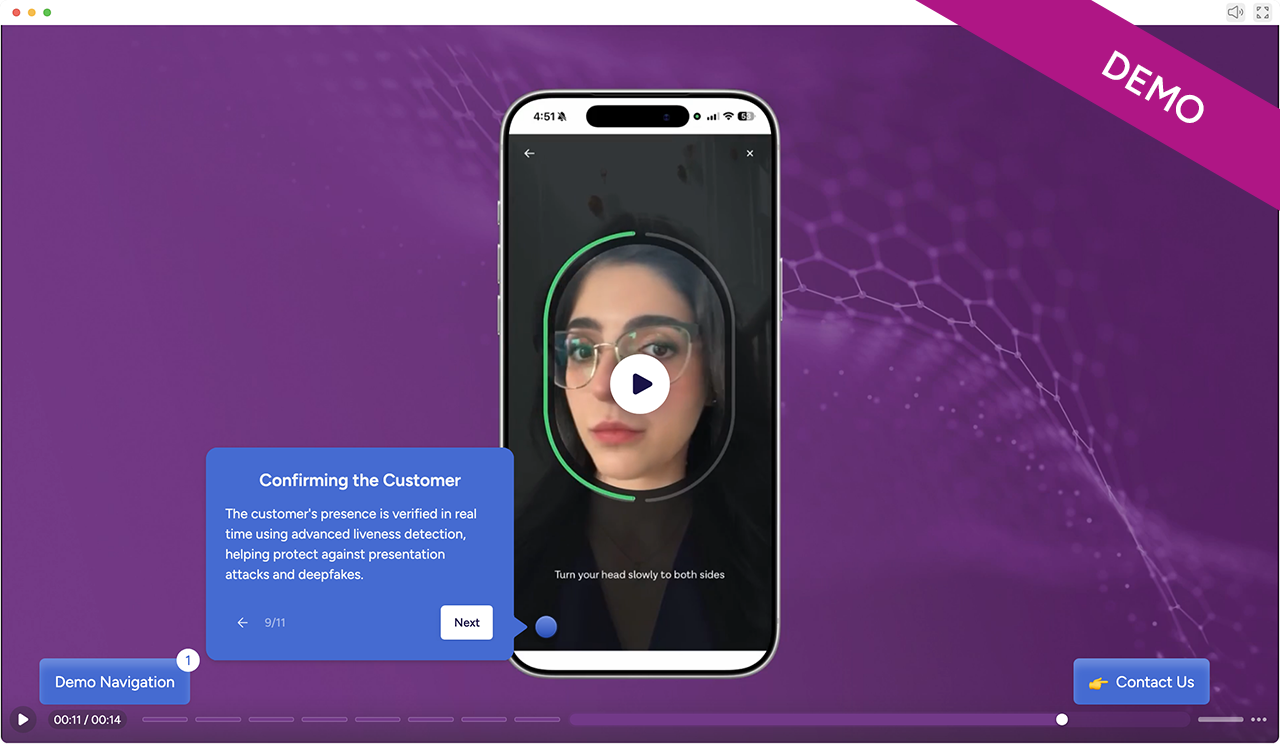
Biometric Authentication Solutions Demo
Ready to discover the ways you can help protect your organization from ATO? Explore this demo to learn key strategies.
The Workforce Identity Crisis
Looking to securely verify employees in the age of AI and impersonation? See how security leaders are addressing workforce identity risk and learn practical steps to verify employees, contractors, and remote workers in the age of AI-enabled impersonation.
See How Biometric Authentication Solutions Fit in Your Stack
Whether you're replacing OTPs, hardening account recovery, or building a risk-adaptive auth layer from scratch, Entrust integrates with what's already working to add a biometric approach.
FAQs
What is biometric authentication?
Biometric authentication is a method of verifying identity using unique physical characteristics, such as facial recognition, fingerprints, or other biometric data. Unlike passwords or OTPs, biometrics confirm that the person accessing an account is the actual account holder.
How do biometric authentication solutions help prevent account takeover?
Biometric authentication solutions verify that the person accessing an account is the legitimate account holder by matching their live biometric data to a trusted identity established at onboarding. This makes it significantly harder for fraudsters to exploit stolen credentials or bypass authentication controls, helping prevent account takeover without adding unnecessary friction.
What is account takeover fraud?
Account takeover fraud occurs when an attacker gains unauthorized access to a user’s account – often using stolen credentials – and impersonates the legitimate user. This allows fraudsters to transfer funds, change account details, or commit further fraud without being detected.
Read more: https://www.entrust.com/blog/2024/11/account-takeover-fraud
Which tools help improve fraud detection in identity workflows?
Traditional MFA methods like OTPs and knowledge-based authentication can be intercepted, phished, or bypassed. Tools such as biometric authentication solutions rely on something the user is, not something they know or have, enabling stronger identity verification and reducing the risk of account takeover, especially during high-risk moments like account recovery or device changes.
Can biometric authentication solutions adapt to different levels of risk?
Yes. Modern biometric authentication solutions can be applied across the user journey, from low-friction login experiences to high-assurance identity verification during sensitive transactions. This risk-based approach helps organizations prevent account takeover while maintaining a seamless user experience for legitimate customers.
How do biometric passkeys improve both security and user experience?
Biometric passkeys are identity-bound, phishing-resistant credentials that use biometrics for authentication. They eliminate reliance on passwords and OTPs, helping prevent account takeover while providing a faster, more seamless login experience that reduces friction and abandonment.
Why is account recovery a critical point for account takeover prevention?
Account recovery is one of the most common entry points for account takeover attacks because it often relies on weaker authentication methods. Biometric authentication solutions strengthen recovery by tying the process back to a verified identity, ensuring that only the legitimate user can regain access to the account.